Autor: Tecnologia Tablu

  • Appload RepStartup Represents Mozambique at Africa Early Stage Investor Summit

    Appload RepStartup Represents Mozambique at Africa Early Stage Investor Summit

    Mozambican startup appload will represent the country at an annual event that brings together startups, investors and investment funds from across the African continent.

    VC4A and the African Business Angels Network (ABAN), entities responsible for the event, announced the 16 startups that will participate in the event, the Africa Early Stage Investor Summit. After a selection process among nearly a thousand applications, the startups were divided into two categories, depending on their stage and investment needs.

    The first category, called Seed, included startups with needs between 400,000 and 8 million US dollars, and the second, Series A, comprises startups with investment needs between 1.5 and 10 million US dollars.

    Appload, which is among the 16 startups in the Seed category, is a Mozambique-based app that connects customers in need of freight transport with carriers, thus contributing to cost efficiency and transparency in the logistics sector. Appload operates in the domestic and cross-border markets.

    The selected startups will participate in this virtual investment forum, which will take place on November 4 and 5. During the month of October, appload founders will have access to training sessions from renowned investors, mentorship on various investment topics, talks with speakers and the opportunity to interact with venture capital funds established on the continent.

    Source

  • The purpose of Tablu Tech

    The purpose of Tablu Tech

    Purpose, purpose, purpose, the answer to so many questions such as, “what differentiates you from your competitors” made by customers, “why should I choose this company to work for rather than the next one” by employees, and “why should we deploy our precious capital in your company than elsewhere” by investors; and the answer is always because of our purpose.

    Most importantly, purpose answers the question: “What would the world lose if your company disappeared?

    It defines a company’s core reason for being and its positive impact on the world, continent, country, or city. It leaves competitors wondering what the difference between them and your company is.

    When we founded Tablu Tech back in 2017, we knew that we ultimately wanted to help our customers achieve their goals as customers and humans through digital products.

    So, our purpose became to we simplify lives with technology.

    But, throughout this journey, while achieving a certain level of maturity in the local market, we knew that to take over the continent and the world, we had to make sure that our purpose was not superficial. It needed to be infused in every aspect of our company, from corporate identity and communication to how we deliver our products.

    And where else to start other than from our brand identity.

    We went from a simple T and U from Tablu to a more meaningful, purpose-infused logo.

    Our Commitment

    We believe that we will be able to deliver on our promise by implementing stable platforms that sit on top of sustainable business models that we can either build or help build.

    Plataformas

    Estabilidade

    Sustentabilidade 

    Programação

    And with these elements in mind, our logo was built.

    This process gave birth to a more dynamic, purpose-driven brand identity that started with our logo and the simple black and white color scheme.

    But we would not stop there. And by using the story brand framework, we defined our mission as to deliver and to help deliver digital products that simplify our customers’ lives.

    Our Mission, Vision, and Values

    Mission: To deliver and to help deliver digital products that simplify our customers’ lives.

    Vision: To change and help change as many lives as possible through digital products.

    Values:

    • Reliability: on every product we build or help build;
    • Culture of Innovation: to constantly find new and better ways of doing things;
    • Constant Progress: to avoid stagnation, on the world’s fastest passed sector;
    • Commitment: to our employees, partners and clients;
    • Collaboration: with our employees, partners, and clients to deliver on our promise;
    • Sustentabilidade: because without it, there is no future.
  • Kuda, the African challenger bank, raises $55M at a $500M valuation

    Kuda, the African challenger bank, raises $55M at a $500M valuation

    Kuda Bank, the London-based, Nigerian-operating startup that is taking on incumbents in the country with a mobile-first, personalised and often cheaper set of banking services built on newer, API-based infrastructure, has been on a growth tear in the last several months, and to fuel its expansion, it has now raised another round of funding.

    TechCrunch has learned, and confirmed with Kuda, that the startup has closed, via its London entity, a Series B of $55 million — money that it plans to use to double down not just on new services for Nigeria, but to prepare its launch into more countries on the continent, and in the words of co-founder and CEO Babs Ogundeyi, to build a new take on banking services for “every African on the planet.”

    The funding was made at a valuation of $500 million, and it comes on the back of some impressive early growth for the startup.

    “We’ve been doing a lot of resource deployment … in Nigeria. But now we are doubling down on expansion and the idea is to build a strong team for the expansion plans for Kuda,” Ogundeyi told TechCrunch in an interview. “We still see Nigeria as an important market and don’t want to be distracted so don’t want to disrupt those operations too much. It’s a strong market and competitive. It’s one that we feel we need to have a strong hold on. So this funding is to invest in expansion and have more experience in the company with relation to expansion.”

    Kuda now has 1.4 million registered users, which is more than double the number it had in March when it had 650,000 registered users — a figure it revealed when announcing its Series A of $25 million led by Valar Ventures.

    We understand that this latest Series B was a relatively quick inside round — that is, it’s coming from existing investors. Co-led by Valar Ventures and Target Global, it also includes SBI and a number of previous angels also participating. Kuda was not proactively raising money at the time the Series B was initiated and closed.

    “We felt that Babs and Musty” — Musty Mustapha, the co-founder and CTO — “are ambitious on another level. For them, it was always about building a pan-African bank, not just a Nigerian leader,” said Ricardo Schäfer, the partner at Target who led the round for the firm. “The prospect of banking over 1 billion people from day one really stood out for me at the beginning.”


    You might notice that it’s only been four months since Kuda last announced a round of funding. Equity rounds raised in quick succession, sometimes just months apart, seems to be the order of the day at the moment, fueled in part by a lot of money being pumped into venture at the moment, but also by the state of the market. When the company in question is showing all the right growth metrics and is working in a particularly buzzy area, many will strike when the iron is hot. (GoPuff, which last week confirmed a $1 billion raise just months after a previous round, is another example of that happening from a different corner of the world.)

    Neobanks — fintechs building a new generation disruptive of banking services based around more modern interfaces and infrastructure based around the concept of API-driven embedded finance — have been one of these areas, growing at a rate of nearly 50% annually in terms of revenues and projected to be collectively a $723 billion market by 2028.

    Within that, we’re seeing a number of strong players emerging across the globe built on this model — Nubank out of Brazil, Revolut and N26 in Europe, WeBank in China, Varo and Chime in the U.S. among them. In this regard, Africa may be the last great untapped region when it comes to banking, one reason why Kuda is seeing strong adoption.

    The writing has been on the wall for years. A report from McKinsey on banking in Africa in 2018 identified a surge of interest in financial services that were delivered digitally, and that growth would be driven by a rapidly evolving middle class of consumers, while at the same time an ongoing dearth of accessible financial services for the majority of the population with some 300 million people still unbanked on the continent. It’s these three basic factors on which Kuda has built its own service.

    Kuda is not the only one building and raising and growing. Others raising money for new fintech plays include payments company Chipper CashAirtel Africa, online lender FairMoney and more.

    However, Kuda is unique among the neobanks in that it is building its services with its own banking license in hand.

    This means that it can be more flexible and fast-moving when it comes to creating new products or tweaking existing ones, and it gives the company another level of credibility in a region where those who were already banking with incumbents might be more wary of new players.

    Indeed, Kuda’s initial business model was built around providing banking services to people who still also held accounts with incumbent banks: People would have their salaries paid into their old accounts and then transferred out to be spent and used in other ways via their Kuda accounts. Ogundeyi said that this is gradually shifting and more people are now bringing both paying-in and paying-out to their Kuda accounts.

    Ogundeyi would not say which countries would be Kuda’s next targets. But he did note that its most recently launched product, Kuda’s first move into credit by way of an overdraft allowance, is a sign of the things to come.

    “It’s a unique product, an overdraft that we pre-qualify the most active users for,” he said. In Q2 it qualified over 200,000 users and pushed out $20 million worth of credit. With a 30-day repayment, he said, so far default has been “minimal” because of the company’s approach.

    “We use all the data we have for a customer and allocate the overdraft proportion based on the customer’s activities, aiming for it not to be a burden to repay,” he added.

    Andrew McCormack, a general partner at Valar Ventures who co-founded the firm with Peter Thiel and James Fitzgerald, said that the still-nascent potential of the market, and how Kuda is approaching that, were behind its decision to invest in the startup another time.

    “Kuda is our first investment in Africa and our initial confidence in the team has been upheld by its rapid growth in the past four months,” he said. “With a youthful population eager to adopt digital financial services in the region, we believe that Kuda’s transformative effect on banking will scale across Africa and we’re proud to continue supporting them.”

    Source

  • Nigeria’s Mono raises millions to power the internet economy in Africa

    Nigeria’s Mono raises millions to power the internet economy in Africa

    In February, Nigerian fintech startup Mono announced its acceptance into Y Combinator and, at the time, it wanted to build the Plaid for Africa. Three months later, the startup has a different mission: to power the internet economy in Africa. It has closed $2 million in seed investment toward that goal.

    The investment comes nine months after the company raised $500,000 in pre-seed last September and two months after receiving $125,000 from YC. Mono’s total investment moves up to $2.625 million, and investors in this new round include Entrée Capital (one of the investors in Kuda’s seed round), Kuda co-founder and CEO Babs Ogundeyi; Gbenga Oyebode, partner at TCVP; and Eric Idiahi, co-founder and partner at Verod Capital. New York but Africa-based VC Lateral Capital also invested after taking part in Mono’s pre-seed.

    In a region where more than half of the population is either unbanked or underbanked, open finance players like Mono are trying to improve financial inclusion and connectivity on the continent. Open finance thrives on the notion that access to a financial ecosystem via open APIs and new routes to move money, access financial information and make borrowing decisions reduces the barriers and costs of entry for the underbanked. 


    Launched in August 2020, the company streamlines various financial data in a single API for companies and third-party developers. Mono allows them to retrieve information like account statements, real-time balance, historical transactions, income, expenses and account owner identification with users’ consent.

    When we covered the company early in the year, it had already secured partnerships with more than 16 financial institutions in Nigeria. In addition to having a little over a hundred businesses like Carbon, Aella Credit, Credpal, Renmoney, Autochek and Inflow Finance access customers’ bank accounts for bank statements, identity data and balances, Mono has also connected over 100,000 financial accounts for its partners and analyzed over 66 million financial transactions so far.

    Mono has done impressively well in a short period. While it appears to have figured out product-market fit, CEO Abdul Hassan is quick to remind everyone that the burgeoning API fintech space is just an entry point to its pursuit of being a data company — a case he also made in February.

    “The way I see it, our market is not that big. Compare the payments market now with 2016, when Paystack and Flutterwave just started. The payments space in 2016 was very small and the number of people using cards online was very small,” said Hassan, who co-founded the company with Prakhar Singh. “It’s the same thing for us right now. That’s why our focus isn’t only on open banking but data. We’re thinking of how we can power the internet economy with data that isn’t necessarily financial data. For instance, think about open data for telcos. Imagine where you can move your data from one telco to another instead of getting a new SIM card and making a fresh registration. That’s where I see the market going, at least for us at Mono.” 

    He adds that the company is taking an approach of building a product one step at a time until it can fully diversify from financial data offerings, including connecting with payment gateways (Paystack and Flutterwave) and other fintechs like wealth management startups Piggyvest and Cowrywise.

    “When you’re able to connect to all the systems, a lot of use cases will come up. The first step is how can we connect to all available data and open it up for businesses and developers,” he continued.

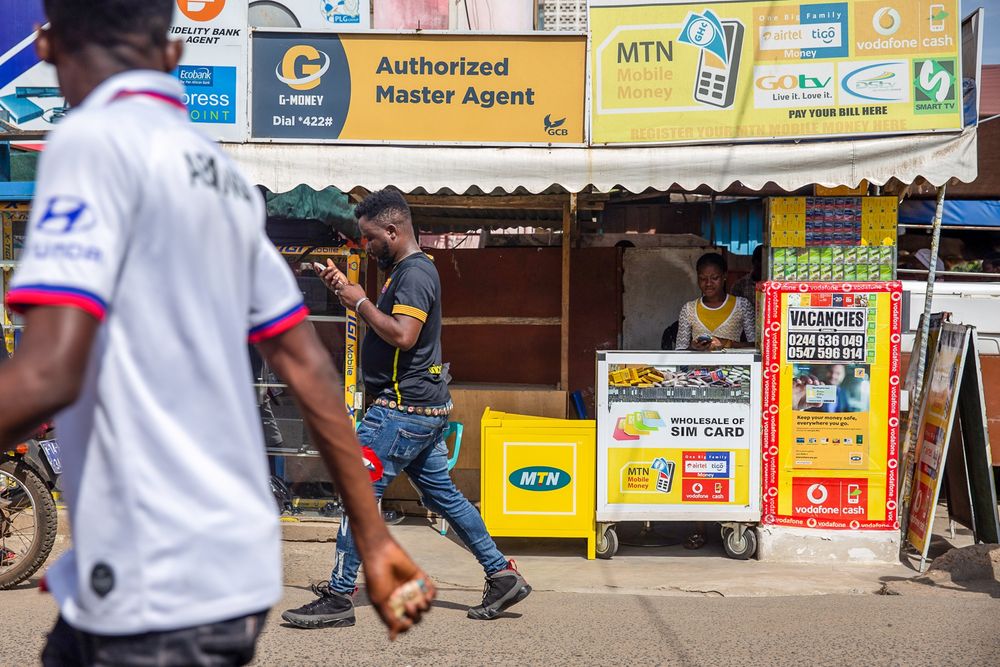
    Therefore, Mono will use the funding to reinforce its current financial and identity data offerings and launch new products for diverse business verticals. Also, a long-overdue pan-African expansion to Ghana and Kenya is top priority. The last time I spoke with Hassan, the end of Q1 looked feasible to get into at least one of the two markets but it didn’t turn out that way. But the wait seems to be over as the company said it’d be going live in Ghana next month with a handful of existing customers from Nigeria and new ones in Ghana. Some of these partners include five banks (GTBank, Fidelity Bank and three unannounced banks) and the mobile money service arm of MTN Ghana.

    “Our expansion is mostly inspired by our customers looking to expand to other markets, same with some of our products. We work with our customers to give them the right tools to build new experiences for their customers,” Hassan stated. 

    Mono is one of three API fintech companies to have raised a seed investment this year. Last month, another Nigerian fintech, Okra, closed $3.5 million while Stitch, a South African API fintech, launched with $4 million in February. Back to back investments like this show that investors are incredibly optimistic about the market. Avil Eyal, managing partner and co-founder of Entrée Capital, one such investor, had this to say: “We are very excited to be working with Abdul, Prakhar and the entire Mono team as they continue to build out the rails for African banking to enable the delivery of financial services to hundreds of millions of people across the African continent.”

    Source

  • Ethiopia Lost $500 Million on Telecom License Mobile-Money Move

    Ethiopia Lost $500 Million on Telecom License Mobile-Money Move

    Ethiopia’s decision to exclude mobile money from the terms of two new telecom licenses cost the government about $500 million from bid levels, Prime Minister Abiy Ahmed said.

    The block imposed to allow the country to build its own expertise in phone-based financial technology will be lifted after about a year, Abiy said at the launch of Telebirr, a mobile-payments service. Ethio Telecom, the state-owned operator, will run Telebirr.


    “This decision has cost us a high price,” the prime minister said. “When it was decided to open up the telecom market about two years ago, one of the key areas of contention was the issue of mobile money.”


    The government has long been in the process of selling two new telecom licenses — a policy that’s at the heart of Abiy’s economic-reform plan. The move will open up one of the last major markets yet to welcome international investors, and is intended to trigger a wider privatization program to raise foreign-exchange and boost productivity.

    The issue of mobile money has been vital to the progress of the auction. Financial technology is a major revenue and profit driver for African telecom operators, who are filling a gap left by traditional banks and taking advantage of soaring smartphone use.

    “Though Ethiopian mobile penetration lags behind peers, investment and lowered prices should lead to strong growth in takeup of mobile services,” Bloomberg Intelligence analyst John Davies said in a note. “The value to international investors depends on agreements with the government and how it chooses to regulate the market.”

    Ethiopia has received a license bid from a consortium including Vodafone Group PlcVodacom Group Ltd. and Kenya’s Safaricom Ltd. Another offer was made by MTN Group Ltd., Africa’s largest wireless carrier, and China’s Silk Road Fund.

    The country is yet to announce the result.

    Source

  • China’s major telecom operators have 310m 5G-connected phones

    China’s major telecom operators have 310m 5G-connected phones

    China’s major telecom operators have 310 million cellphone terminals connected to their 5G networks by the end of April, the Ministry of Industry and Information Technology (MIIT) said Tuesday. 

    The number accounts for about 19 percent of the total mobile phone users of the three basic telecom operators – China Telecom, China Mobile and China Unicom. 

    Home to the world’s largest 5G mobile network, China has seen more innovative applications of the new communication technology in a thriving, lucrative sector. 

    To date, there have been more than 9,000 new cases of 5G applications in China, such as the introduction of smart construction sites with higher management efficiency and lower safety risks, according to the ministry. 

    The MIIT predicted that in 2025, 5G will directly lead to the creation of 2.93 trillion yuan (about $457 billion) in economic value added (EVA). 

    Last year, 5G directly led to 810.9 billion yuan in gross economic output, according to a white paper on 5G development and its economic and social impact. The China Academy of Information and Communication Technology released the white paper in April. 

    The industry directly generated 189.7 billion yuan of EVA and indirectly brought about 2.1 trillion yuan in gross output in 2020, the white paper said. 

    The MIIT estimated that 5G mobile phone shipments in China would account for 80 percent of the total shipments in the second half of this year.

    Source

  • Europe plans sat-nav and telecoms network at the Moon

    Europe plans sat-nav and telecoms network at the Moon

    The European Space Agency is proposing a precise navigation system at the Moon, much like the sat-nav technology we have here on Earth.

    It would enable spacecraft and astronauts to know exactly where they are when moving around the lunar body and to land with precision.

    The initiative, known as Moonlight, would also incorporate a telecommunications function.

    A large flotilla of lunar missions will be launched this decade.

    Chief among them will be the US space agency-led successor to Apollo. Called Project Artemis, this will put crews on the Moon for the first time in more than 50 years.

    “We are entering a new phase – the systematic exploration of our ‘eighth continent’, the Moon,” said David Parker, the director of human and robotic exploration at Esa.

    “The Moon is a repository of 4.5 billion years of Solar System history, but we’ve hardly begun to unlock its secrets. And so Moonlight is something that we see as really exciting, as a necessary infrastructure to support sustained exploration.”

    Esa is asking two industrial consortia in Europe to define what an integrated sat-nav and telecoms system at the Moon would look like.

    It’ll include a constellation of at least three, but probably more, positioning-and-relay satellites to give global coverage, and will likely include some surface beacons, too, to augment the accuracy of the navigation signals.

    “The target we have at the moment is that the constellation would be able to allow for an accuracy of 100m and probably better. We think we are able to get to 30m in the first instance,” explained Paul Verhoef, the director of Esa’s navigation department.

    Moonlight is just at the feasibility stage at the moment – what is known in industry-speak as a Phase A/B1 study.

    The consortia will put their thinking on the technologies required in reports to Esa, who will then produce a defined and costed proposal to go before Europe’s research ministers when they gather for their triennial council meeting next year.

    One consortium will be led by the UK small satellite manufacturer, Surrey Satellite Technology Limited. SSTL assembled the navigation payloads on the European Union’s Galileo sat-nav system.

    The other group will be fronted by the Italian space systems company Telespazio. One of its team-members is London-based Inmarsat, which is a world leader in satellite telecommunications for on-the-move applications, such as in ships and planes.

    For those nations and companies thinking of sending spacecraft to the Moon this decade, having access to the proposed Esa network would help de-risk their ventures and reduce their cost.

    And it would make the remote operation from Earth of, say, rovers and telescopes on the far-side of the Moon a lot easier because the system would bring very high data rates back to Earth.

    “There is a full landscape of possibilities that you can imagine now: An astronomer could set up observatories on the far side of the Moon; rovers could travel more speedily on the lunar surface; and as we have all now become accustomed to virtual meetings – who knows, we could be doing Skype on the Moon,” speculated Elodie Viau, Esa’s director of telecoms.

    The expectation is that Esa will pursue a commercial model for the constellation, which is to say it will buy a service from an operator rather than own the system or any of the hardware.


    “I think that’s the way it will go,” commented Nick Shave, vice president of strategic programmes at Inmarsat. “Esa will run it from a service-based perspective and leave a level of risk with the consortium. That’s why it’s really important now that we establish the business case and get the income model right.”

    If this is the way it’s done, all manner of customers – from private entities to the big space agencies, such as Esa and Nasa – will need to see the utility of contracting out their sat-nav and data-relay needs.

    Certainly, this seems to fit with the current direction of travel. Nasa is purchasing cargo-delivery and even crew-landing services from commercial providers as part of its Artemis project.

    And Esa, too, has started down this road by giving a telecoms service contract to SSTL for its Lunar Pathfinder satellite, which can be seen as a kind of prototype for Moonlight. Indeed, it will test receiver technology that can be used to fix a position in space.

    The production of Pathfinder is being self-financed by the Guildford-based company. And when it’s flying in 2023/24, it will sell its relay service to any and all who want to use it.

    The plan is to put Pathfinder into a highly elliptical orbit so that it can have long periods of visibility over the Moon’s South Pole – the planned destination of early Artemis missions.

    “Pathfinder is important for us because it will sound out the market,” said Nelly Offord, the head of business for exploration at SSTL.

    “When you’re looking to commercialise something, it’s much easier to start on a smaller scale with one spacecraft, to make sure the service is right for communication.

    “Pathfinder will also be able to interact with the future constellation. So, if you like, it will sort of become the first node of the constellation.”

    Source

  • China’s fintech giants are hitting roadblocks in planned listings at home

    China’s fintech giants are hitting roadblocks in planned listings at home

    Months after the sudden suspension of Ant Group’s highly-anticipated dual listing, China’s financial technology companies are facing difficulties trying to go public in the mainland, analysts told CNBC.

    According to EY’s Asia-Pacific IPO leader, Ringo Choi, few firms in the fintech sector have managed to list on mainland exchanges in Shanghai and Shenzhen.


    “For financial technology, you can see that … some of the largest one(s), if they’re competing with the bank or insurance company, they will have a hard time,” Choi told CNBC.

    Last Friday, the China Securities Regulatory Commission announced a series of updated guidelines for companies seeking to list on the Shanghai’s STAR market — the Nasdaq-style tech board officially known as the Shanghai Stock Exchange Science and Technology Innovation Board.

    One of the guidelines was that financial technology companies were banned from listing on the STAR board. “Real estate and firms mainly engaged in financial services and investment businesses are prohibited from listing on the Science and Technology Innovation Board,” the CSRC said in the release.

    The latest development presents yet another obstacle for Chinese fintech companies looking to list on the mainland.

    It comes weeks after Chinese e-commerce giant JD.com withdrew the planned listing of its financial technology arm on the STAR market.


    The current IPO climate is a stark contrast to the situation less than six months ago, when a slew of Chinese start-ups were planning to list domestically. One such listing was the highly-anticipated public debut of Alibaba-affiliate Ant Group — poised at that time to become the world’s largest IPO.

    Ant’s planned listing — set to take place in both Shanghai and Hong Kong — was abruptly shelved days before the debut after top executives including its founder and controller, Jack Ma, were summoned by Chinese regulators for questioning.

    The unexpected suspension largely marked a turning point in Beijing’s stance toward its domestic technology giants including fintech firms, which had enjoyed largely unencumbered growth for years.

    “The sentiment for this sector face(s) some questions,” Bruce Pang, head of macro and strategy research at China Renaissance Securities (Hong Kong), told CNBC.

    He said firms in the financial technology sector are now looking toward Ant’s “rectifications” of its business as an “example” for others that are looking to list on the mainland.

    Earlier in April, Chinese regulators ordered Ant — which runs the massively popular mobile payments app Alipay in China — to revamp its business. Reuters reported over the weekend that the fintech powerhouse is exploring options for its founder Ma to divest his stake and give up control — but Ant swiftly denied those claims as “untrue and baseless” in a post from its official Twitter account.

    Looking elsewhere

    Financial technology firms that are currently facing a “closed door” trying to raise capital on the STAR board may seek listings elsewhere, said Pang.

    The U.S. and Hong Kong are still viable options for Chinese financial technology firms looking for alternative destinations to go public, according to the analysts.

    One example of a Chinese fintech firm that has successfully listed outside the mainland is Lufax, which had a U.S. IPO in late 2020.

    The Securities and Exchange Commission will likely “give a pass” to Chinese firms wanting to list in the U.S. as long as the companies are able to meet the requirements of full disclosure, said EY’s Choi. As for Hong Kong, the process may be “more stringent,” but they still have a chance to go public too if the requirements are met.

    Still, potential delisting concerns for Chinese firms stateside may weigh on investor sentiment. Under a new law passed by the administration of Donald Trump, the SEC can stop the trading of securities that fail to meet its auditing requirements.

    Source

  • Get Nando’s cheaper through Vodacom – how it works

    Get Nando’s cheaper through Vodacom – how it works

    Vodacom customers can buy Nando’s food vouchers, ranging between R27 and R82, at a discounted rate through the Vodacom app.

    These vouchers were launched as part of Vodacom’s new Voucher Advance service which allows Vodacom customers to buy food and appliances on credit.

    Through Voucher Advance, Vodacom customers can buy vouchers ranging between R25 and R1,000 and have 30 days to pay for the voucher.

    Users don’t have to pay any interest, and each voucher is valid for three years from the issue date.

    To qualify for Voucher Advance, customers need to have been active on the Vodacom network for at least six months and have a proven track record of buying airtime or data bundles.

    Mariam Cassim, chief officer of Vodacom financial and digital services, said the service allows their subscribers to enjoy a meal at Nando’s and pay later at 0% interest.

    The Voucher Advance service is available to Vodacom’s prepaid and top-up subscribers. Contract customers are, however, not left out.

    There is a “buy now” option where post-paid subscribers can purchase Nando’s and Hirsch’s vouchers at a discounted rate.

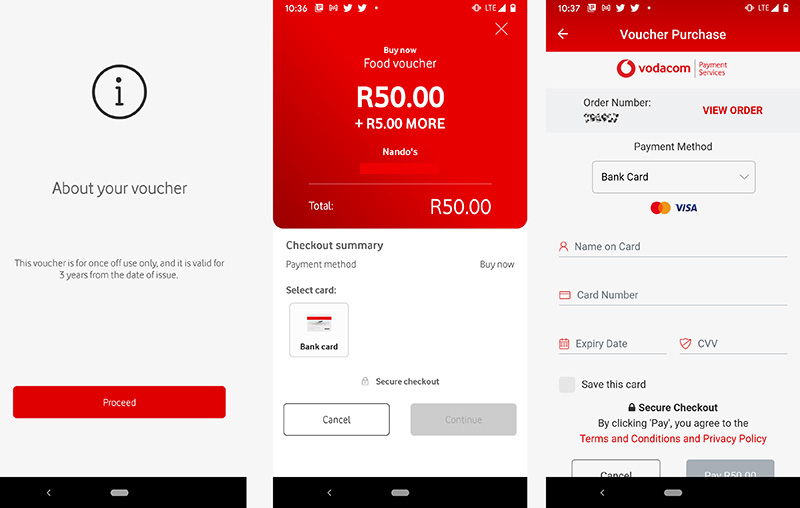
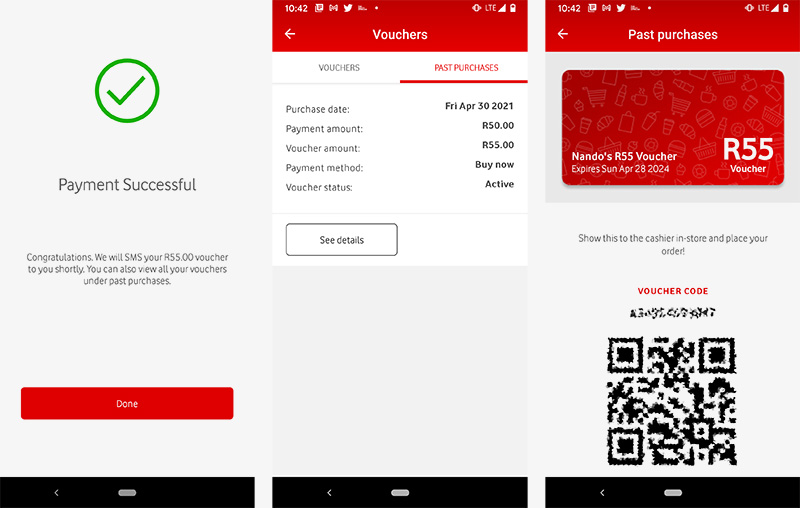
    With the buy now option, users purchase the voucher using a credit card. After the purchase they receive a QR code which can be used in-store.

    The vouchers which are currently available to Vodacom post-paid subscribers are:

    • R25 Nando’s voucher, which gives you R27 to spend.
    • R50 Nando’s voucher, which gives you R55 to spend.
    • R75 Nando’s voucher, which gives you R82 to spend.
    • R250 Hirsch’s voucher, which gives you R262 to spend.
    • R500 Hirsch’s voucher, which gives you R525 to spend.
    • R1,000 Hirsch’s voucher, which gives you R1,050 to spend.

    MyBroadband took the new Vodacom voucher service for a spin and it worked exactly as promised.

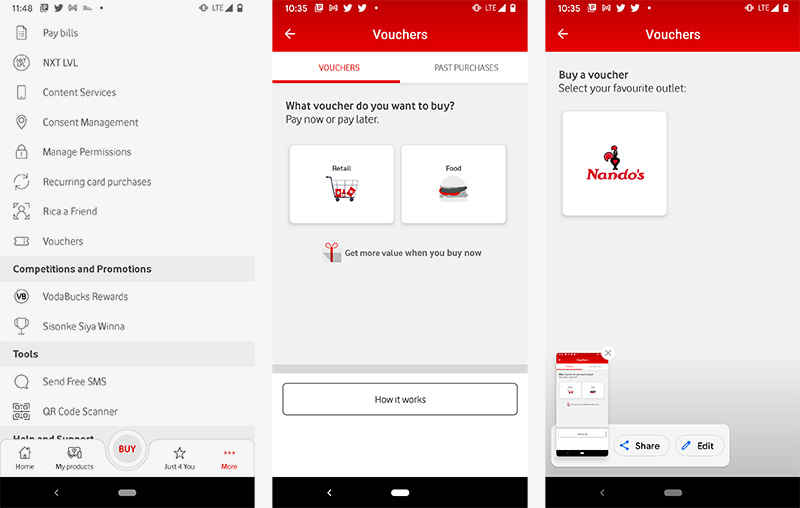
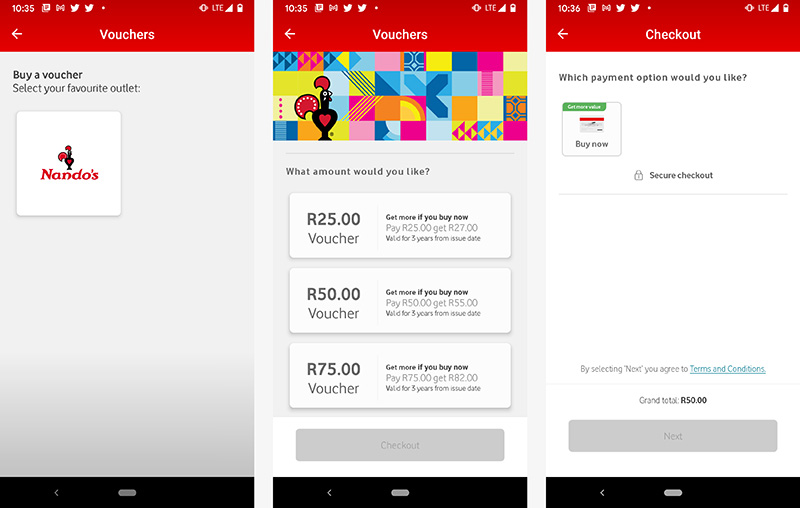
    After opening the Vodacom app, you click on “more” in the bottom menu bar and select “Vouchers”.

    You are then given the option to select “Retail” or Food”. We selected Food and proceeded to purchase a R50 Nando’s voucher (which actually gives you a R55 voucher).

    The checkout process was smooth and within minutes after payment we received a voucher with a QR code which could be used at any Nando’s outlet.

    The screenshots below show the voucher purchasing process using the Vodacom app.

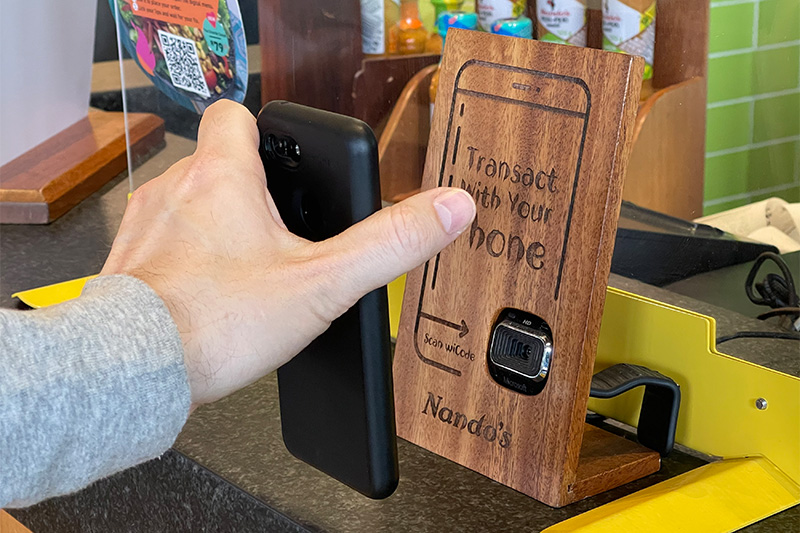
    Armed with our R55 voucher, we visited the local Nando’s store and placed an order for an original boujee bowl and a chocolate milkshake.

    When it was time to pay for the meal, we informed the cashier that we want to use a Vodacom voucher.

    She knew exactly how the system worked and asked us to scan the voucher QR code using the camera paypoint.

    R55 was taken off the cost of the meal and we settled the rest using cash.

    The overall experience was much smoother than expected. It worked exactly as expected without any hiccups or payment problems.

    Vodacom has clearly invested heavily in the system to iron out problems before it was launched.

    As for the Nando’s meal – the chocolate milkshake was delicious and the original boujee bowl is always a winner.

    Source

  • M-Pesa CEO: Savings, wealth management and insurance the next big opportunities for fintech in Africa

    M-Pesa CEO: Savings, wealth management and insurance the next big opportunities for fintech in Africa

    There is still ample room for growth for mobile money throughout Africa, according to Sitoyo Lopokoiyit, interim CEO of M-Pesa Africa.

    During a session at the recent Africa Financial Industry Summit, Lopokoiyit revealed year-on-year growth of around 20% is possible over the next five years.

    “The future of mobile money in Africa is fantastic. We are leapfrogging the card generation and going straight into digital financial services and payments.”

    In 2007, Kenyan mobile network operator Safaricom launched the revolutionary mobile money platform M-Pesa, which allows subscribers to transfer money between one another and deposit and withdraw cash through a network of agents. The service has since been expanded to several other African countries.

    For Lopokoiyit, future growth in the fintech space resides within the provision of financial health solutions.

    “On financial inclusion when M-Pesa started, it was about 23% [in Kenya]. In places like Kenya, it is [now] 84% and above; in Tanzania, it is about 70%. But while that has been really good, financial health has remained relatively low … at about 20%. In this area of fintech and mobile money, we need to start looking at areas in which we can provide savings, wealth management and insurance to be able to cushion customers on the shocks that they may have as they live their lives,” he said.

    Covid-19, said Lopokoiyit, has, once again, made the impact of external shocks on financial health abundantly clear.

    He wants fintech players to be more innovative in developing these solutions and finding ways to make financial products – even those such as government bonds – available to a wider range of customers.

    Encouraging innovation and seeking strategic partnerships

    M-Pesa is hoping to encourage this innovation by opening its platform even more to third party developers.

    “How do we encourage more developers and fintechs to come into our ecosystem and innovate?” he asked. “Today in Kenya, there are 29,000 developers on our platform. I would like to see 100,000 developers across Africa use our APIs to develop innovate products and services.”

    Referencing the recent announcement that Silicon Valley financial services company Stripe had acquired Nigerian start-up Paystack, Lopokoiyit explained partnerships of this nature are key for African fintech companies to get the valuations they deserve. “If you look at the talent that is being recruited from Africa by the big tech companies it shows that there is potential.”

    The intention to establish M-Pesa as a super app that will feature various services such as transport, tourism, e-commerce and utility payments on one platform, was reiterated by Lopokoiyit.

    He believes partners would be able to publish their offering onto the super app, immediately adding value to the M-Pesa subscriber (more choice) and providing 40 million potential customers to the partner (access to market). “I want customers to look at [the M-Pesa app] as much as they look at WhatsApp on a daily basis, or Instagram.”

    Regulators are your friend

    Lopokoiyit wants fintech companies and innovative start-ups to embrace engagement with regulators in their jurisdictions. “We work with them every single time. There is no product and service that we launch without the regulator. We actually have discovered it is better to, even on a concept stage, to engage the regulator.”

    He further touted the importance of considering a regulator’s perspective when they fulfil their mandate to protect the consumer from systemic risk. “We are commercially driven, we are about transforming lives, but the regulators look at it from a bigger and broader scope; they interact with other regulators across the world, so they do add a lot of value,” he said.

    Covid – the great accelerant

    Lopokoiyit is clear about the impact Covid-19 has had on digital financial services; it has sped up adoption, as well as regulatory change and innovation.

    There are three phases when looking at the impact of Covid-19, he explained. First, there was the response period from March 2020 when most countries went into hard lockdowns. During this time, various businesses, regulators and governments were looking specifically at how they could assist communities. “We worked, for example, with central banks on lowering or zero-rating transaction fees below $10 to drive more financial inclusion,” he said. Other projects included working with governments to enable disbursements of much-needed relief finance to vulnerable communities. “That showed the impact of mobile money especially in Africa.”

    The second phase is one of rebuilding. “This is really critical for the future of businesses in Africa. As we open up, how do we look at SMEs and micro-SMEs; how can we help them get back to business?” he asked. Possible interventions could be in one or all of four areas: capacity building; providing working capital at affordable rates; value-added services such as accounting solutions or simplifying cross-border payments; and improving connectivity at affordable rates.

    The third phase is reimagining. “We’ve seen areas such as e-commerce really accelerate in the last nine months. Somewhere like Kenya, where we expected to be in 2025, has happened now.” It is time to rethink how to enable businesses to operate in the new dispensation post-Covid-19.

    As an example, he listed the number of M-Pesa merchants at 157,000 in March 2020. By September of last year, this had already grown to 170,000. “I think this shift is permanent towards the digital channels,” said Lopokoiyit.

    Source